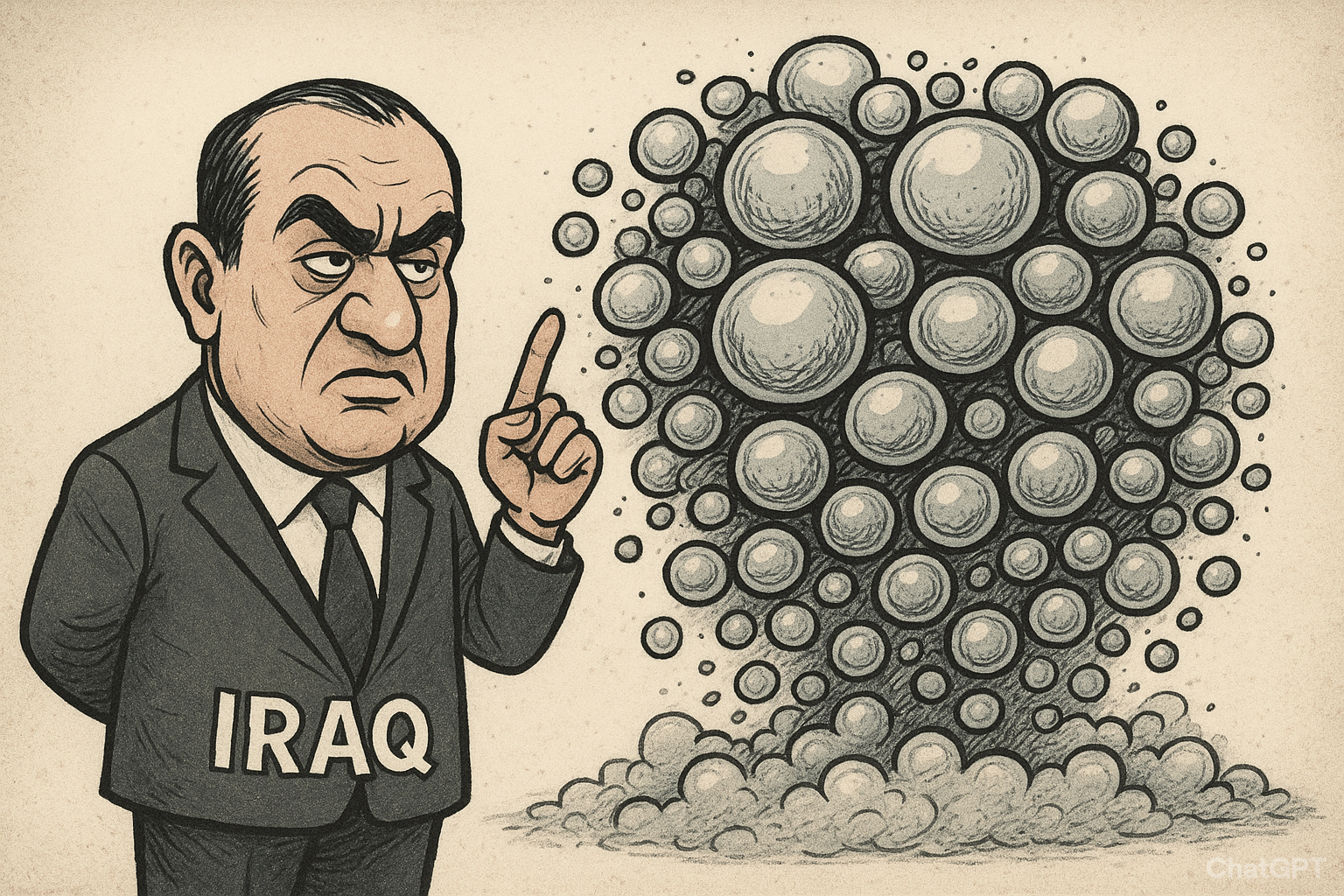

Iraqi foam
It is enough to follow Iraqi satellite channels to understand the extent of the fragmentation that the country is experiencing. The media, which is supposed to be a public platform that expresses the concerns of all citizens, has turned into a mosaic of partisan and sectarian platforms. Each channel broadcasts its own speech, addresses its own audience, and creates an internal world isolated from others. Thus, public opinion is divided between neighboring media bubbles, not united by a common public space as much as they are divided by narrow interests and affiliations.
The concept of public space according to Jurgen Habermas remains one of the most attractive perceptions in modern social and political thought. He imagined a free space in which citizens would meet on common ground and discuss their issues away from the control of the state and market pressures, thereby establishing a rational civil society that would make dialogue the basis of democracy. In its historical moment, this vision seemed to be a promise that enlightenment could be achieved through free speech and public debate.
But this dream faced harsh criticism with Peter Sloterdijk. In his trilogy Spheres (Bubbles – Balls – Foam), Sloterdijk rejected the idea that humans live in one public space. In his view, the world is like an enormous foam: millions of small bubbles that represent the inner worlds of groups and individuals, each one closed in on itself, but adjacent to others without dissolving into a comprehensive unity. Thus, the image of the world transforms from a single public square to a fragmented foam, without a center, without a common space, but rather small compact worlds that sometimes coexist and sometimes collide.
At this point, the question arises: Which picture is closer to the Iraqi reality?
The answer seems closer to the second diagnosis. During the last two decades, a pattern of social and political fragmentation has deepened in Iraq, with the national structure transformed into adjacent bubbles: (sectarian, national, regional, and partisan), and even separate digital spaces, each with its own world. Each bubble creates its own narrative and breathes within its narrow world, but it remains unable to create a common air that unites it within a broader national framework. This fragmented foam makes every political crisis an identity crisis as well, and makes the public space fragile, conflicted, and fragmented.
However, fragmentation is not final. Here the importance of civil society emerges as the force capable of connecting bubbles together. When civil society is independent of the state and the market, it provides the necessary air for the foam to transform into a broader communicative space. But when civil society is hijacked by partisan or economic forces, it loses its function, and reality returns to its frothy, fragmented form.
The philosophy here is not satisfied with diagnosis, but rather pushes us to rethink: If Iraq lives today as a foam of contiguous bubbles, can this foam be transformed into positive energy, so that diversity becomes a source of wealth instead of a factor of disintegration?
It is not just a comparison between Habermas and Sloterdijk, but rather a mirror of our Iraqi situation. Between the dream of public space and the reality of fragmented foam, the question remains outstanding: Can Iraq find a unifying center that creates common air between all the bubbles, or will the foam remain its destiny, which wastes its energy and prevents it from cohesive?